Four season plantings that thrive in the Northeast
From winterberry fruit and red-twig dogwood to switchgrass, smooth hydrangea, and late-blooming asters, a plant-by-plant guide to a Northeast garden with year-round interest.
A great Northeast garden does not peak for two weeks and then disappear. It changes character. Spring brings emerging shoots and small flowers worth leaning in to see. Summer is about generous foliage and layers of bloom. Autumn delivers color, seed, and movement. Winter reveals the framework: branching, bark, persistent fruit, and evergreens holding their shape against snow.
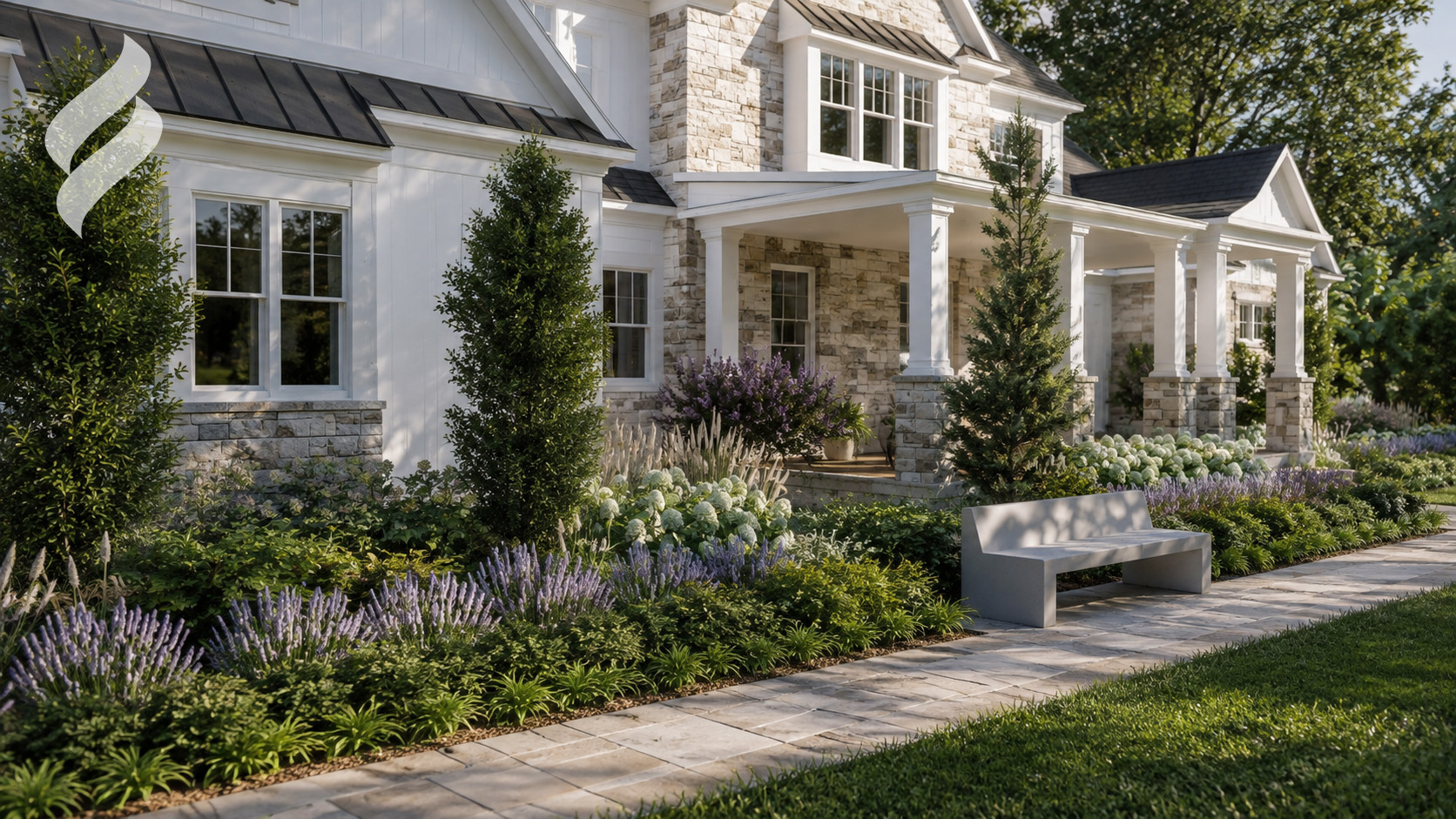
The plant-nerd question is not simply, ‘What color does it flower?’ It is, ‘What does this plant contribute before flowering, after flowering, and when everything around it is dormant?’ A four-season planting is a community of plants with overlapping jobs—not a promise that every individual plant looks spectacular every month. Here is a closer look at the material that can make that community work. The opening image illustrates layered planting design; it is not a botanical identification guide.
First, define your site—not just your season
The Northeast is not one growing condition. A sheltered Long Island garden, a Pennsylvania clay slope, and an exposed Vermont property can call for very different palettes. Cold tolerance is only the first filter; it does not tell you whether a plant can handle your drainage, summer drought, road salt, or deer pressure. Study light, soil, and moisture before ordering plants.
The mature sizes below are general species-level guides. Cultivars, growing conditions, and local climate change the details. Bloom windows are approximate and usually arrive later on colder sites. ‘Native’ also needs precision: a species native somewhere in North America is not automatically native to your county. Use regional native-plant guidance when habitat restoration or locally adapted planting is the priority.
Threadleaf bluestar: Amsonia hubrichtii
Amsonia hubrichtii deserves more attention than a flower-color label. It forms a rounded clump roughly 2–3 feet tall and wide, and its narrow, threadlike leaves create a softness that reads beautifully beside stone, clipped evergreens, or the broad leaves of hydrangeas. It is native to parts of the south-central United States rather than the Northeast, but it performs well on suitable sites here.
Upright shoots unfold into fresh green foliage in spring, then clusters of small, pale blue, star-shaped flowers arrive in late spring—an airy, close-up kind of beauty rather than an electric-blue billboard. The fine summer foliage becomes a substantial feathery mound, and by autumn it can turn a remarkable golden yellow against darker evergreens. Give it full sun to partial shade and well-drained soil; too much shade encourages floppy stems. It is dormant in winter, so let grasses, berries, or evergreens take over the visual work.
Spring: flowers, emerging foliage, and the ground layer
Baptisia australis—blue false indigo—is another plant whose value extends well beyond its blue-violet flowers. It develops into a substantial clump about 3–4 feet tall and wide. Late-spring flower spires rise above blue-green, trifoliate foliage. The habit is almost shrub-like through summer; inflated seedpods can later darken and add another layer of interest. Full sun and well-drained soil are the starting point. Its deep root system makes an established plant difficult to move, so select its location with mature size in mind. Do not mistake a small nursery plant for a small mature perennial.
Tiarella cordifolia—foamflower—answers a different design problem: what happens at ground level in a shaded garden? It brings low, lobed foliage and delicate white to pinkish-white spring flower spikes, usually reaching about 6–12 inches in flower. It prefers partial to full shade and humus-rich, moist but well-drained soil. Some forms spread more readily than others. Leaves may persist through mild conditions, but do not promise a flawless evergreen carpet after a severe winter. Use it where its foliage can knit together beneath taller plants without being baked by afternoon sun.
Together, spring plants should do more than provide isolated dots of bloom. Foamflower gives the lower layer continuity; fine-textured bluestar adds softness; Baptisia supplies height and mass. Their light and moisture needs differ, so this is a design vocabulary, not an instruction to put every species in the same bed. Match each to the correct part of the site.
Summer: durable foliage and flowers with an afterlife
Echinacea purpurea—purple coneflower—grows around 2–4 feet tall, with considerable variation among cultivars. Summer brings the familiar raised central cone and pink-purple ray flowers of the species. Full sun, good air movement, and well-drained soil help it perform. Flowering can continue across the summer, but timing and persistence vary with weather and plant selection. Straight species and simpler flower forms are useful choices when accessible pollen and nectar are priorities; a highly doubled flower should not be assumed to offer the same resources.
After flowering, resist the urge to remove every head. The dark cones can add structure into fall and winter, and the seeds may feed birds. Deadheading some stems can keep a prominent border looking fresh, while leaving others lets the plant complete its seasonal story. A coneflower bed that is seasonally dormant is not a failed landscape. It simply needs neighboring plants with a different moment of interest.
Hydrangea arborescens—smooth hydrangea—grows about 3–5 feet tall and wide, although named cultivars differ. It flowers on current-season growth. The species has a more delicate flower structure than many familiar large-headed cultivars; select the actual plant, not just the genus name. Summer flower heads can age into papery tan forms that remain attractive later in the year. Partial shade and consistently moist, well-drained soil are a reliable starting point. More sun is possible where moisture is adequate, but a hot, dry exposure may mean wilting and irrigation demands.
Smooth hydrangea is deciduous, not a year-round screen. Give it space to grow as a shrub instead of repeatedly cutting it to fit a narrow foundation strip. Avoid transferring its pruning rules to every hydrangea: bigleaf and oakleaf types do not behave identically. Understanding which wood carries the flowers prevents the frustrating experience of pruning away the next display.
Fall: the garden’s second peak—not an afterthought
Symphyotrichum novae-angliae—New England aster—brings purple to pink flowers with yellow centers in late summer and fall, just as many earlier perennials quiet down. The species can reach 3–6 feet tall. Full sun and moist, well-drained soil suit it; compact cultivars offer different dimensions. It is an important late-season floral resource for insects. Lower stems can look bare, so place it behind a lower planting layer rather than expecting it to behave like a tidy edging plant. A deliberate early-season cutback may reduce height, but late pruning can sacrifice the flowers you were waiting for.
Panicum virgatum—switchgrass—is a warm-season grass, meaning it starts actively growing later than many cool-season plants. That timing is useful: it takes over as spring interest fades. Species plants often reach 3–6 feet, with named cultivars ranging in size, leaf color, and habit. Fine-textured flower panicles float above the foliage in summer; leaves and stems can age to yellow, gold, or tan in fall. Some selections develop red tones. Check the cultivar rather than assuming all switchgrass looks alike.
Use full sun for a stronger upright habit. Switchgrass tolerates a range of soils, including periodically moist conditions, but shade or overly rich conditions can contribute to flopping. Leave sound stems standing where they add winter movement, then cut back before new growth begins in spring. Around walkways, account for the full mature spread and snow-laden stems. A grass that looks graceful from the window should not become an obstacle at the front door.
Itea virginica—Virginia sweetspire—adds a woody layer to the fall palette. Species plants can reach about 4–8 feet tall and 3–6 feet wide, with compact cultivars available. White, arching flower racemes appear in late spring or early summer, but the red to purple autumn foliage is often the headline. Full sun to partial shade and moist soil suit it; it can spread by suckers. Use that habit where a colony is welcome rather than in a tiny space that must remain rigidly controlled. It flowers on the previous season’s wood, so prune after flowering if pruning is needed. Its native range includes New Jersey southward and westward; verify local status instead of calling it native to every Northeast site.
Now imagine switchgrass catching low afternoon light, an aster holding purple against the fading summer, and sweetspire adding deeper reds. That is a sequence of textures and colors, not a row of plants selected only because they bloom in October. Repeat a few compatible species in intentional groups so the autumn garden feels composed rather than collected.
Winter: berries, bark, and evergreen architecture
Ilex verticillata—winterberry holly—is deciduous. Losing its leaves is exactly what makes the fruit so visible. Species plants range roughly 3–12 feet tall and wide, so cultivar selection matters enormously. It thrives in moist, acidic soil and can tolerate wet sites, with sun to partial shade. Female plants need a compatible male pollinator flowering at the same time to set fruit. A red-berried female cultivar and an arbitrary male holly are not a guaranteed match: confirm the pairing with the nursery.
Fruit can provide a striking fall and winter display and food for birds, but its persistence varies with weather and wildlife. Do not promise berries until spring. Place winterberry where bare branches and fruit can be appreciated from a daily route or a window. The fruit is for the landscape and wildlife, not for human consumption; consider children and pets when siting fruiting ornamentals.
Cornus sericea—red-osier or red-twig dogwood—makes its strongest argument after leaf fall. Younger stems have the most vivid winter color. The species can grow 6–9 feet tall and spread into a colony. It prefers moist soil and sun to partial shade. This is not a miniature shrub unless you select a smaller cultivar. White flowers and later pale fruit contribute in the growing season, but the red stems against a pale background are the winter payoff.
Renewal pruning removes a portion of the oldest stems near the base in late winter or early spring, encouraging younger, more colorful growth. Some vigorous established plants can be cut back more strongly, but that approach sacrifices some flowering and should not become an automatic instruction for every planting. Use a maintenance plan suited to plant health and your priorities. The best winter color is the outcome of both plant selection and thoughtful care.
Thuja occidentalis—eastern arborvitae or northern white cedar—provides a persistent evergreen framework. The species is a tree that can reach 40–60 feet; garden cultivars may be dramatically smaller or narrower. Select by named cultivar and mature dimensions. Sun and moist, well-drained soil are a good starting point. Avoid treating a roadside, salt-exposed strip or a dry foundation trench as an automatically suitable location.
Arborvitae is not deer-proof. Browsing can strip lower foliage, especially in winter, and snow or ice can affect branching. Assess deer pressure before using it as your only screening plant. Evergreen structure is essential, but a single-species wall is not the only answer. Mix an appropriate evergreen framework with deciduous branching, grasses, and fruiting shrubs so the garden retains depth even if one element has a difficult season.
Build a four-season planting palette that actually fits
For a sunny, well-drained border, start with repeated groups of Baptisia australis and Echinacea purpurea, then use an appropriately sized switchgrass selection for late-season height. Add New England aster where moisture is sufficient and its mature habit can be accommodated. The sequence moves from spring blue to summer flowers, then seedheads, autumn bloom, and standing grass. These are candidates to assess, not a universal recipe for every Northeast yard.
For a partial-shade or moister garden, consider a foamflower ground layer, smooth hydrangea for summer mass, and sweetspire for autumn color. Winterberry and red-osier dogwood may suit wetter parts of the site, provided their mature scale, soil requirements, and spreading behavior are acceptable. Do not flatten the property’s natural moisture differences just to force one planting list across it.
A restrained palette can still be botanically rich. Repeat plants to create continuity, vary leaf size to create contrast, and leave space for their eventual dimensions. Fine, threadlike foliage against broad hydrangea leaves offers more lasting depth than a border chosen entirely for flower color. View the composition from inside the house as well as from the path: winter planting especially earns its place when it is visible from a room used every day.
Care is part of the design
Plant performance begins below ground. Check drainage, avoid burying root crowns or tree root flares, and use a soil test when pH or fertility is uncertain. Water new plants according to root-zone moisture and weather, not a fixed calendar that treats every bed the same. Drought tolerance describes established performance; a recently planted perennial or shrub still needs help building roots.
Be selective about cleanup. Leave healthy seedheads and standing stems where they add habitat and visual interest; remove diseased material and clear plants that obstruct paths or drainage. Spring cutback timing should reflect local conditions and new growth rather than one universal date. Keep mulch off crowns and trunks, and do not use repeated heavy fertilization as a substitute for matching plants to the site.
A four-season landscape is not maintenance-free, and ‘thrives in the Northeast’ is never a guarantee independent of conditions. It is a thoughtful relationship between plants, soil, exposure, climate, and care. Get that relationship right and the garden becomes more rewarding to watch: not only when the flowers open, but when the foliage emerges, the light changes, and the last leaves fall.
Four-season planting questions
Do these plants bloom all season? No. Most have a defined window, and some contribute foliage, seed, bark, or form instead of flowers. That is exactly why a four-season planting works: different plants take turns, and the border keeps changing instead of peaking once.
Which plants give a Northeast garden winter interest? Site-appropriate evergreens, winterberry fruit, young red-osier dogwood stems, and standing switchgrass or coneflower seedheads can all contribute. Choose a combination rather than expecting a single plant to provide screening, flowers, berries, and texture throughout the year.
Can a four-season garden also support wildlife? Yes. Thoughtful regional native-plant selection, accessible flowers across the growing season, fruit, and retained healthy stems can add resources. Match species to your location and do not assume every ornamental cultivar provides the same habitat value as its species.
Where should I begin? Start with your winter view, then map sun, soil moisture, and mature plant sizes. Establish the woody framework first and layer spring, summer, and autumn interest around it. A seasonal planting plan is more useful than buying one attractive flowering plant at a time.
Planning a new landscape in Pennsylvania or the Northeast? We would love to hear about your property.